

The Forest
Description
Please note that the time limit for this problem is 5s!
Explorer A and Explorer B need to use light bulbs to light up this forest.
There are light bulbs, numbered . Explorer A uses red ropes to connect them into a tree, and Explorer B uses blue ropes to connect them into another tree.
At the beginning, all bulbs are off. Now we want to turn on some of the bulbs. Explorer A likes connected components, and Explorer B likes paths. They want to know: how many ways are there to turn on bulbs such that the turned-on bulbs form a connected component in A's tree, and form a path in B's tree?
Input Format
The first line contains an integer , meaning there are test cases. For each test case:
The first line contains an integer .
Lines to , i.e. line , contain two integers , representing an edge in A's tree.
Lines to , i.e. line , contain two integers , representing an edge in B's tree.
Output Format
Output lines. The -th line is the answer for the -th test case.
3
3
1 2
2 3
1 2
1 3
5
1 2
1 3
2 4
2 5
1 2
2 3
3 4
4 5
5
3 1
3 2
3 4
3 5
1 2
2 3
3 4
3 5
5
9
14
Hint
Sample Explanation:
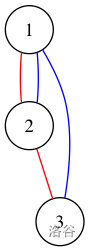
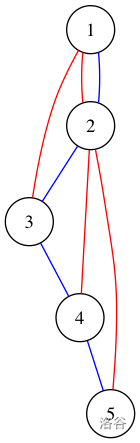
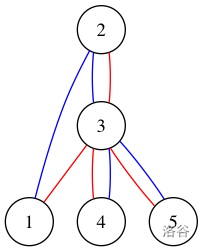
Diagrams for the three test cases:
Sample 1:
Sample 2:
Sample 3:
For the first test case, the valid sets of bulbs to turn on are:
- ;
- ;
- ;
- ;
- .
Note that you cannot turn on the set , because bulbs and do not form a connected component in A's tree. You also cannot turn on the set , because bulbs and do not form a path in B's tree.
For the second test case, the valid sets of bulbs to turn on that contain at least two bulbs are:
- ;
- ;
- ;
- .
Clearly, all bulb sets of size are valid, so the answer is .
Constraints and Notes:
For of the testdata, , and it satisfies the special constraint .
For of the testdata, , and it satisfies the special constraint .
For of the testdata, it satisfies the special constraint .
For of the testdata, .
Special constraint : , that is, B's tree is a path, and there is an edge between nodes with adjacent indices.
Translated by ChatGPT 5
 京公网安备 11011102002149号