

[Celeste-B] Say Goodbye
Description
Madeline shared the strawberries she collected with her friends.
The bright red strawberries and the golden yellow strawberries were mixed together, and her friends liked them very much.
To thank Madeline, her friends collected many colorful beads and planned to string them into a colorful necklace as a gift for Madeline.
After careful preparation, there are now beads on the table. These beads have colors in total. Specifically, there are beads of the -th color.
Looking at the crystal-clear beads on the table, the friends are now troubled, because they do not know how to string them together to make it the most beautiful.
They ask you for help: compute the total number of essentially different plans.
They cannot tell the order of beads apart, so two beads are different only if their colors are different.
This necklace must be complete, so all beads form one connected component.
The necklace also cannot be too messy, so all beads must form a unicyclic graph (基环树).
After asking Madeline’s friends many times, you find that two subtrees of this unicyclic graph are different if and only if the colors of their corresponding nodes are different, or the two subtrees have different structures. Different subtrees are considered ordered.
For example, the following partial stringing methods are all different from each other.
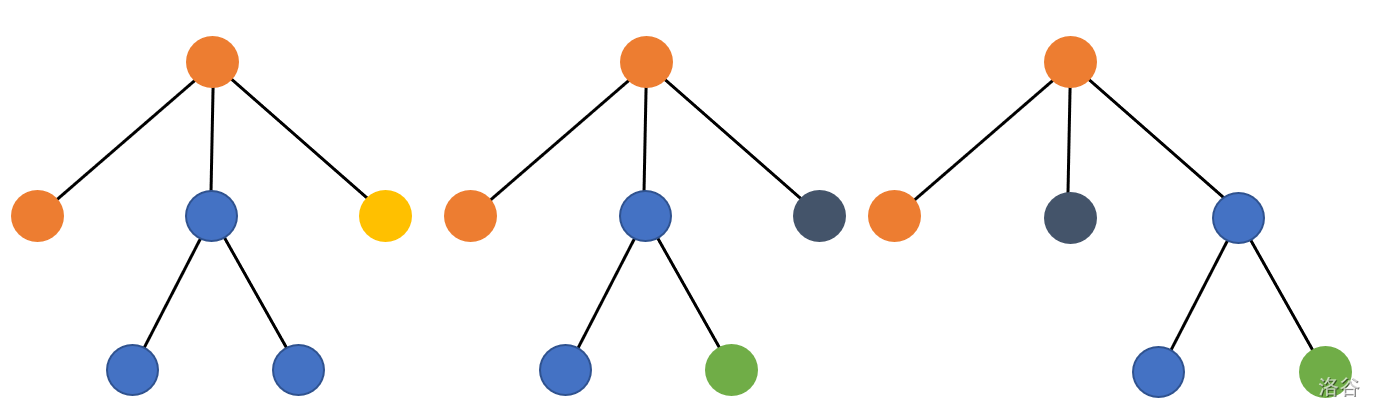
The friends are in a hurry, so if two necklaces can become the same by rotating the cycle (基环), then these two necklaces are essentially the same.
Input Format
The first line contains two integers , representing the total number of beads and the number of colors.
The next line contains integers , representing the number of beads of each color.
Output Format
Output one integer, the number of plans modulo .
3 3
1 1 1
8
4 2
1 3
15
Hint
Unicyclic graph (基环树): a connected graph with vertices and edges, with no self-loops. It is easy to see that such a graph consists of a cycle with some trees attached to it.
Cycle (基环): the cycle in a unicyclic graph.
For of the testdata, .
For another of the testdata, and .
For the first of the testdata, .
For another of the testdata, and .
For the first of the testdata, .
For of the testdata, , , , and .
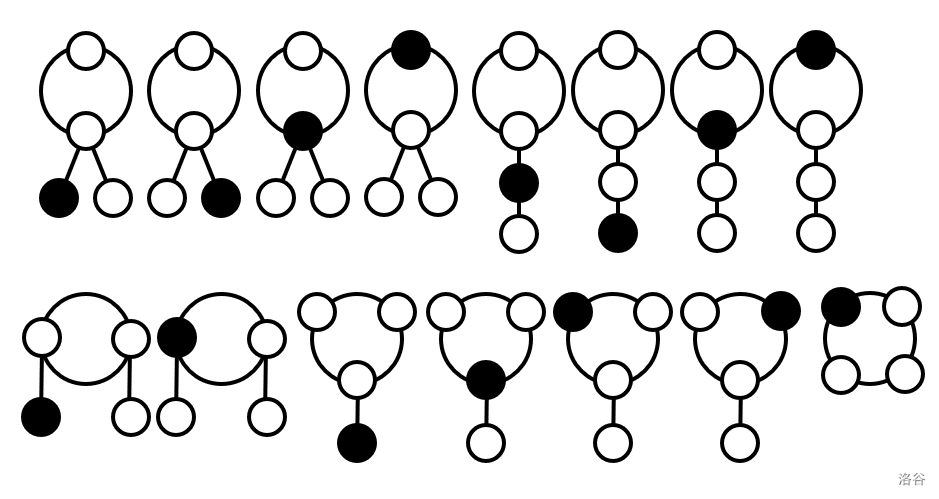
Explanation for the second sample:
There are cases as follows:
Translated by ChatGPT 5
 京公网安备 11011102002149号